

Amazon MQ: When to Use AWS’s Managed ActiveMQ Over Native Messaging Services
Choosing between compatibility and cloud-native scale in modern AWS messaging architectures

Your enterprise has 150 Java applications built over the last decade, all communicating through IBM WebSphere MQ using JMS. The data center contract expires in eight months. Leadership wants everything in AWS. The cloud architect proposes rewriting to SQS. The project manager laughs that’s 18 months of work minimum, full regression testing, and significant risk.
This is where Amazon MQ enters: AWS’s managed Apache ActiveMQ service that lets you migrate JMS-based systems without rewriting application code. It’s not a cloud-native service like SQS or SNS it’s a managed deployment of traditional message broker software. That distinction matters enormously.
Amazon MQ exists to solve migration problems, not to be your long-term messaging architecture for new systems. Understanding this positioning and knowing when to use it versus SQS, SNS, or EventBridge separates successful AWS messaging strategies from expensive architectural mistakes.
What Amazon MQ Is
Amazon MQ is managed Apache ActiveMQ running in your VPC. AWS handles patching, backups, and infrastructure, but you configure the broker, manage queues and topics, and handle client connections. This is broker-based messaging, not serverless primitives.
The key difference from SQS/SNS: you’re operating message broker infrastructure that AWS manages, not consuming a fully-abstracted cloud service. This operational model matters for capacity planning, scaling, and cost structure.
Architecture Pattern Comparison:
Migration Path:
┌─────────────────────┐
│ Legacy Apps (JMS)   │
│ On-Prem ActiveMQ    │────────────┐
│ IBM MQ / RabbitMQ   │            │
└─────────────────────┘            │
                                   ▼
                            ┌─────────────┐
                            │  Amazon MQ  │
                            │  (Managed   │
                            │  ActiveMQ)  │
                            └─────────────┘
                                   │
                        Minimal Code Changes

Cloud-Native Path:
┌─────────────────────┐
│ New Microservices   │
│ Serverless Apps     │────────────┐
│ Event-Driven Arch   │            │
└─────────────────────┘            │
                                   ▼
                    ┌──────────────────────────┐
                    │  SQS / SNS / EventBridge │
                    │  (AWS-Native Services)   │
                    └──────────────────────────┘
                                   │
                        Deep AWS Integration
Protocol Support: The Migration Value
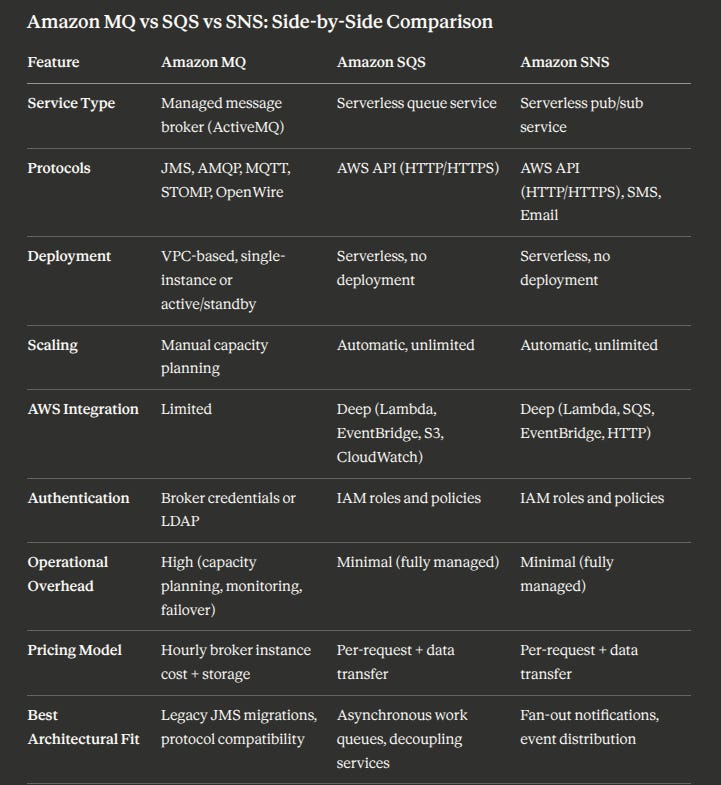
Amazon MQ supports JMS, AMQP 1.0, MQTT, OpenWire, and STOMP. This protocol compatibility is the entire point. Enterprise applications built against these APIs over the past 15-20 years can migrate to AWS with minimal code changes often just connection string updates.
SQS and SNS only support AWS-specific APIs and HTTP-based protocols. If your Java application uses JMS with IBM MQ or on-premises ActiveMQ, migrating to SQS requires significant refactoring. Amazon MQ eliminates that rewrite.
Protocol support also enables polyglot architectures: Java services using JMS, IoT devices using MQTT, and legacy systems using STOMP all through one broker.
Messaging Models: Queues and Topics
Point-to-Point (Queues): Messages consumed by exactly one receiver. Multiple consumers can connect, but each message delivers to only one. The broker tracks state, acknowledgments, and redelivery.
Publish-Subscribe (Topics): Messages delivered to all active subscribers. Durable subscriptions persist messages for offline subscribers something SNS doesn’t provide without additional SQS queue subscriptions.
The architectural difference: Amazon MQ provides broker-mediated messaging with transactions, message selectors, and complex routing. SQS/SNS are service-mediated with simpler semantics but deeper AWS integration.
Deployment Options and High Availability
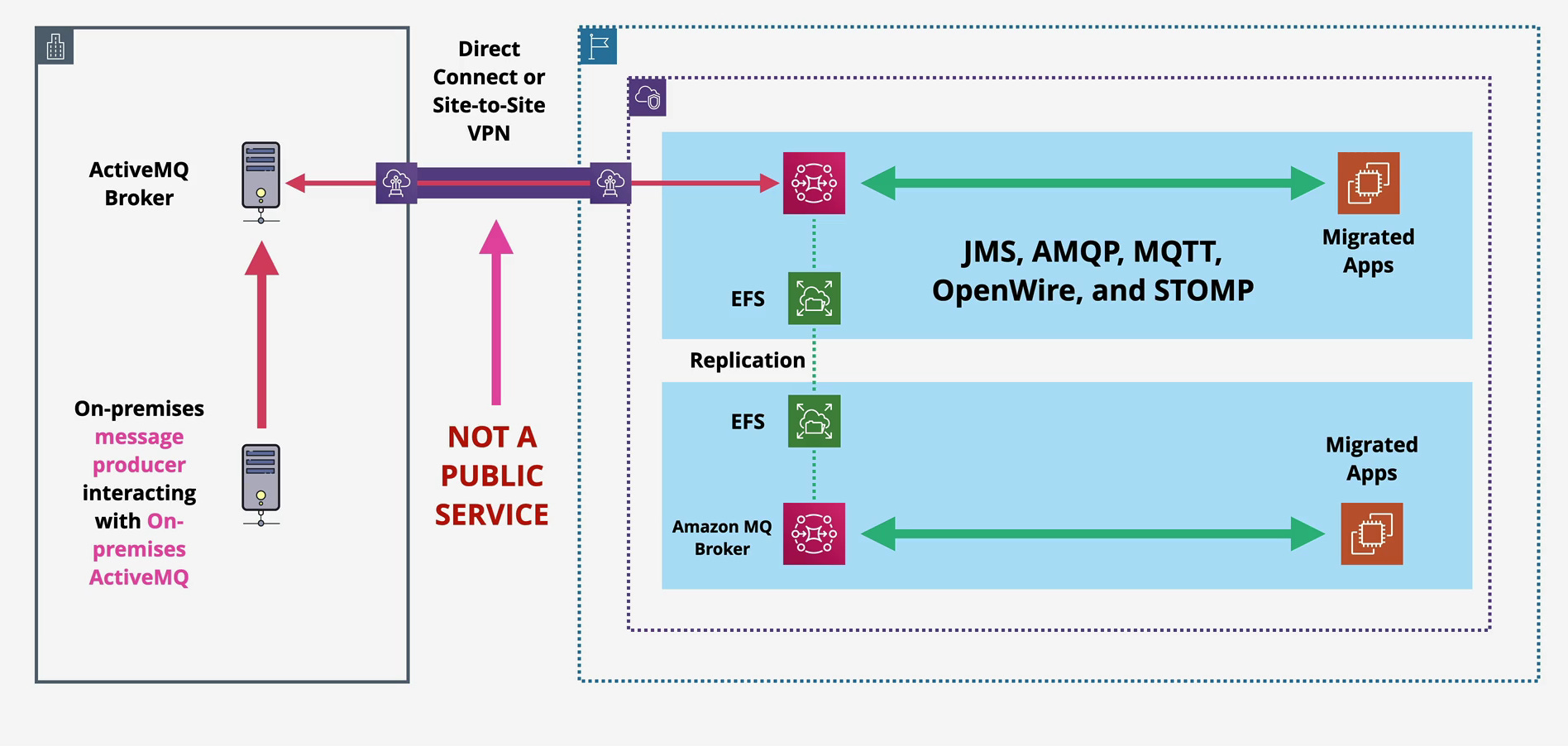
Amazon MQ offers two deployment modes, each with distinct operational characteristics:
Single-Instance Brokers A single broker node running in one Availability Zone. Suitable for development, testing, and cost-sensitive non-production workloads. If the broker fails or the AZ has issues, your messaging infrastructure is down until AWS recovers the instance or you deploy a new broker. There’s no automatic failover.
Active/Standby Deployments Two broker instances across two Availability Zones with synchronous replication. The active broker handles all traffic while the standby maintains a replicated copy of the message store. If the active broker fails, Amazon MQ automatically promotes the standby and updates the DNS record to point clients to the new active instance.
The failover process is not instantaneous. Client applications must implement retry logic and handle brief connection interruptions during failover. This typically takes 1-2 minutes, though AWS doesn’t provide strict SLAs on failover time. Plan for this in your application design.
Cost vs. Resilience Tradeoff Active/Standby roughly doubles your cost you’re paying for two brokers even though only one actively serves traffic. For production workloads requiring high availability, this is justified. For batch processing, development, or applications with lenient downtime tolerances, single-instance deployments can significantly reduce costs.
The VPC Requirement: Private Networking Only
Amazon MQ is fundamentally a VPC-based service with no public endpoint option. Your brokers exist within your VPC, bound to specific subnets and protected by security groups. This architectural decision has significant implications:
You cannot access Amazon MQ directly from the public internet without additional infrastructure (like VPN or Direct Connect). If you’re running hybrid architectures with on-premises systems, you need private connectivity. If you have microservices in different VPCs, you need VPC peering, Transit Gateway, or PrivateLink configurations.
This contrasts sharply with SQS and SNS, which are public AWS services accessible via HTTPS from anywhere with proper IAM credentials. The VPC requirement adds networking complexity but provides network-level isolation that some security policies mandate.
Integration Limitations: Not a Native AWS Citizen
Amazon MQ doesn’t integrate with AWS services the way SQS and SNS do. SQS queues are event sources for Lambda. SNS topics trigger Step Functions and fan out to multiple targets. EventBridge routes events to dozens of AWS services.
Amazon MQ has none of this:
No Lambda event source mapping you’d need self-managed consumers polling from a VPC, adding operational overhead
No EventBridge integration
Limited IAM integration authentication uses broker credentials, not IAM roles
No AWS SDK convenience methods you use ActiveMQ client libraries (JMS, AMQP)
This is intentional. Amazon MQ exists for protocol compatibility, not cloud-native integration patterns.
When to Use Amazon MQ: The Critical Decision Framework
This is the most important section. Let’s be direct: for greenfield AWS-native applications, SQS and SNS should be your default choice. They’re serverless, deeply integrated with AWS services, support IAM-based permissions, scale automatically, and align with cloud-native architectures.
Why SNS and SQS Win for AWS-Native Systems:
Serverless operations: No brokers to size, configure, or monitor
Automatic scaling: No capacity planning required
Deep AWS integration: Lambda, EventBridge, Step Functions, CloudWatch, X-Ray
IAM-native security: Use roles and policies, not broker-level credentials
Pay-per-use pricing: No baseline broker costs
Built-in encryption: KMS integration without broker configuration
CloudWatch Logs integration: Automatic logging and metrics
No VPC complexity: Accessible from anywhere with IAM credentials
When Amazon MQ Makes Sense:
Amazon MQ is the right choice in specific, well-defined scenarios:
1. Migration from Legacy Enterprise Messaging
Your organization runs on-premises ActiveMQ, IBM MQ, RabbitMQ, or similar brokers. Applications use JMS extensively. Refactoring to SQS would require rewriting significant portions of your codebase, testing against new semantics, and retraining teams.
Example scenario: A financial services company has 200 Java applications using JMS with IBM WebSphere MQ. They want to move to AWS quickly. Amazon MQ lets them migrate with minimal code changes update connection strings, configure network connectivity, and they’re operational. The alternative refactoring 200 apps to use SQS would take months or years.
2. Protocol-Specific Requirements
Your architecture depends on AMQP, MQTT, STOMP, or OpenWire. IoT devices using MQTT, legacy systems using STOMP, or AMQP-based integrations with third-party systems can’t easily switch to AWS APIs.
Example scenario: A manufacturing company has thousands of IoT sensors publishing data via MQTT. Their edge devices have MQTT client libraries embedded in firmware. Switching to AWS IoT Core MQTT would require firmware updates across deployed hardware. Amazon MQ provides MQTT compatibility immediately.
3. Advanced Messaging Patterns
You need message selectors, distributed transactions (XA), complex routing rules, or durable topic subscriptions with offline message persistence features ActiveMQ provides but SQS/SNS don’t.
Example scenario: A healthcare system needs JMS message selectors to filter messages based on properties without consuming them. Clinical systems subscribe to patient update topics with durable subscriptions, receiving messages even when offline for maintenance.
4. Lift-and-Shift with Minimal Risk
Your priority is migrating quickly with minimal changes to prove AWS viability, planning to modernize incrementally over time. Amazon MQ reduces migration risk by maintaining existing application behavior.
Example scenario: A retail company wants to exit their data center in six months. Their e-commerce platform uses ActiveMQ for order processing, inventory updates, and email notifications. They migrate the entire stack to AWS using Amazon MQ, then gradually refactor services to use SNS/SQS over the following year.
Where EventBridge Fits in This Landscape
EventBridge is AWS’s event bus service distinct from messaging primitives like SQS and SNS. It’s the routing backbone for event-driven architectures, not a replacement for queues or pub/sub.
What EventBridge Provides:
Event routing with pattern matching: Route events to different targets based on content
Native SaaS integration: Connect directly to Salesforce, Zendesk, Datadog, and 80+ partners
Schema registry: Define and discover event structures
Archive and replay: Store events long-term and replay for testing or recovery
The Architectural Position:
Amazon MQ = Enterprise middleware compatibility for legacy systems
SQS/SNS = Cloud-native messaging primitives (queues and topics)
EventBridge = Event-driven architecture backbone for routing and integration
EventBridge works with SQS and SNS as targets. You might use EventBridge to receive events from AWS services, apply routing rules, then send to SQS queues or SNS topics for processing. This is fundamentally different from Amazon MQ’s protocol compatibility mission.
For greenfield event-driven architectures, EventBridge is often the starting point—not because it replaces SQS/SNS, but because it orchestrates event flow across your entire system, including external SaaS tools.
Operational Realities
Capacity Planning Is Your Responsibility
Unlike SQS/SNS, Amazon MQ requires capacity planning. You choose instance types (mq.t3.micro to mq.m5.4xlarge) based on expected message throughput, connection count, and storage needs. Undersize your broker, and you’ll hit performance bottlenecks. Oversize it, and you’re wasting money.
Monitor CloudWatch metrics like CpuUtilization, StorePercentUsage, and ConnectionCount. Plan for growth. Scaling requires changing instance types, which means downtime for single-instance brokers or a controlled failover for active/standby deployments.
Security Model
Amazon MQ security follows traditional infrastructure patterns, not IAM-first AWS patterns:
Security groups control network access to broker ports
TLS/SSL encrypts client connections
Broker-level encryption protects stored messages
LDAP/AD integration for authentication (limited IAM support)
This is infrastructure security, not IAM policy-driven security like SQS.
Cost Structure: The Numbers
SQS/SNS pricing is simple: pay per request. Amazon MQ pricing is infrastructure-based: you pay hourly for broker instances regardless of message volume.
Amazon MQ Baseline Costs (us-east-1):
mq.m5.largesingle-instance: ~$350-400/monthmq.m5.largeactive/standby: ~$700-800/month
SQS Cost Examples:
10 million requests = ~$4 (standard queue)
100 million requests = ~$40
1 billion requests = ~$400
The Crossover Point:
For low-volume workloads (under 100M messages/month), SQS is dramatically cheaper. A system processing 50 million messages monthly costs ~$20 with SQS vs $400-800 with Amazon MQ.
For high-volume sustained traffic (500M+ messages/month), Amazon MQ becomes cost-competitive if you’re already sizing brokers appropriately. At 1 billion messages monthly, SQS costs ~$400 while Amazon MQ costs $700-800 for active/standby—closer, but still not cheaper.
The real economics: Amazon MQ makes financial sense when protocol compatibility saves you $50,000+ in application refactoring costs, not when it’s cheaper to operate. Choose Amazon MQ to avoid migration expenses, not to optimize runtime costs.
The Migration Reality
Protocol compatibility doesn’t mean zero effort. You’ll still need to:
Redesign networking (VPC, security groups, private connectivity)
Update monitoring (CloudWatch metrics vs your current tooling)
Test failover behavior and client retry logic
Validate performance under production load
Train operations teams on AWS-specific management
It’s faster than refactoring to SQS, but it’s not zero effort.
Common Misuse of Amazon MQ
Using Amazon MQ for brand new microservices If you’re building greenfield applications, SQS and SNS provide better AWS integration, simpler operations, and serverless scaling. Amazon MQ adds unnecessary complexity when you have no legacy constraints.
Choosing it because “enterprise” sounds better Amazon MQ isn’t more “enterprise” than SQS it’s for specific compatibility scenarios. Enterprise-grade messaging on AWS means choosing the right tool, not the most traditional one.
Ignoring capacity planning responsibilities Unlike SQS, you must size brokers based on throughput projections. Many teams underestimate this operational burden and discover performance issues in production.
Assuming failover is seamless Active/Standby failover takes 1-2 minutes and requires client retry logic. Applications must handle connection interruptions gracefully. This isn’t plug-and-play high availability.
Using Amazon MQ as a Lambda event source While technically possible with custom polling, it defeats Lambda’s serverless design. If you need Lambda integration, use SQS with native event source mapping.
The Architect’s Decision Checklist
Choose Amazon MQ if:
You’re migrating existing applications using JMS, AMQP, MQTT, or STOMP
Refactoring to SQS/SNS would require extensive code changes
You need protocol-specific features (message selectors, XA transactions, complex routing)
Timeline pressures favor lift-and-shift over greenfield redesign
You have specific compliance requirements for broker-based messaging
Your architecture requires durable topic subscriptions or other ActiveMQ-specific features
Choose SQS/SNS if:
You’re building new applications on AWS
You want serverless operations with zero infrastructure management
You need deep AWS service integration (Lambda, EventBridge, S3 events)
You prefer IAM-based security over broker-level authentication
You want automatic scaling without capacity planning
Your message patterns fit simple queuing or pub/sub models
Hybrid Approach: Consider using both. Migrate legacy systems to Amazon MQ while building new services on SQS/SNS. Use Amazon MQ as a bridge receive messages via JMS, publish to SNS for AWS-native fanout, or pull from SQS to feed into ActiveMQ topics. This lets you modernize incrementally without big-bang rewrites.
Conclusion: Know When You’re Choosing Legacy
Amazon MQ solves one problem exceptionally well: migrating legacy JMS and protocol-dependent systems to AWS without massive rewrites. For this use case, it’s invaluable.
But understand what you’re choosing: If you’re building new systems on AWS and you select Amazon MQ, you’re importing legacy constraints into a system that doesn’t require them. Use it to migrate. Not to design forward.
The strategic framework is simple:
Migrating legacy systems? Amazon MQ removes the rewrite barrier.
Building new on AWS? SQS, SNS, and EventBridge provide cloud-native patterns without broker overhead.
Need protocol compatibility forever? Amazon MQ is your answer, but know you’re accepting operational complexity.
The best architects don’t choose technologies based on what sounds enterprise or what worked on-premises. They choose based on actual constraints: timelines, existing codebases, team capabilities, and long-term operational models.
Amazon MQ exists because real-world migrations are messy, timelines are tight, and sometimes the fastest path forward is the one that works with what you already have. Just don’t mistake migration convenience for architectural best practice.

great summary! i learned alot about MQ vs SQS on AWS